AIM/HYPOTHESIS
Because there was no signal for ORF2 on the stripped blots in 1. Detection of endogenous ORF2p in N2102Ep using Streptavidin-polyHRP80_Jan 29 2020, I will run a new gel with new material to see if that gives us a signal.
MATERIALS
| Name | Company | Cat. nr. | Date received/made | Comments | ||||
|---|---|---|---|---|---|---|---|---|
| N2102Ep cell powder | ||||||||
| a-ORF2 beads | 9/17/2019 | Rabbit IgG | ||||||
| a-ORF2p antibody | Rabbit, (Clone 5, 0.325 mg/ml), 1:500, 4°C, overnight | |||||||
| Biotinylated Anti-Rabbit IgG (H+L) | Kirkegaard & Perry Laboratories (KPL) | 16-15-06 | 1:1000; dissolved in 1mL H20 to 0.5mg/mL. Made aliquots of 50 and 12 uL and stored at -20. Freezer under Lars' bench | |||||
| STREPTAVIDIN POLY-HRP80 CONJUGATE | Fitzgerald | 65R-S105PHRP | 1:10.000; stored at -20. Freezer under Lars' bench | |||||
| Streptavidin Protein | Thermo Scientific | 21122 | 1:2000; stored at 4 degrees, 2nd refrigerator, box #1 | |||||
| D(+)-Biotin, 98%, ACROS Organics™ | Fisher Scientific | AC230090010 | 0.25 mg/mL; stored at 4 degrees, 2nd refrigerator, box #1 | |||||
METHODS
- Fresh a-ORF2 IP with 500mg (2x 250), 100 mg of N2102Ep (Hua did 1g), with 10ul of beads per 50mg. Take along MT289 as positive control (only whole cell lysate). Performed according to Immunoprecipitation with antibody conjugated Dynabeads from cell powder.
- Elute both 250mg IPs in 10ul 1.1x LDS and pool the elutions.
- Wash beads and elute another time
Sonication:
1) 100mg | 18 J
2) 250mg (1) | 18 J
3) 250mg (2) | 18 J
I forgot to take the input, which was anyway not relevant for this purpose because since we don't see it in the elution so far, we can never get the input concentrated enough for endogenous ORF2 detection.
Gel was loaded as follows;
1) ladder
2) N2102Ep 100mg FT
3) N2102Ep 250mg (1) FT
4) N2102Ep 250mg (2) FT
5) ladder
6) N2102Ep 100mg E (1)
7) N2102Ep 500mg E (1)
8) N2102Ep 100mg E (2)
9) N2102Ep 500mg E (2)
10) space
11) ladder
12) MT298_3 (7.5ug)
13) MT298_3 (15ug)
14) ladder
And using the following protocol for detection of ORF2.
Steps:
1. Block using 5% not-fat milk in 1x TBST for 1hr at RT
2. Wash 1x 5’ with 1x TBST
3. Block endogenous biotin with Streptavidin (5 µg/mL in 1x TBST + 5% BSA) for 1h at RT
4. Wash 3x 5’ with 1x TBST
5. Block exogenous Streptavidin with exogenous biotin (0.25 mg/mL in 1x TBST + 5% BSA) for 1h at RT
6. Wash 3x 5’ with 1x TBST
7. Incubate with primary antibody dissolved in 1x TBST + 5% BSA at 4°C o/n
8. Wash 3x 5’ with 1x TBST
9. Incubate with biotinylated secondary antibody dissolved in 1x TBST + 5% BSA at for 1hr at RT
10. Wash 3x 5’ with 1x TBST
11. Incubate with Strep-PolyHRP80 dissolved in 1x TBST + 5% BSA
12. Wash 3x 5’ with 1x TBST
13. Detect by chemiluminescence
RESULTS
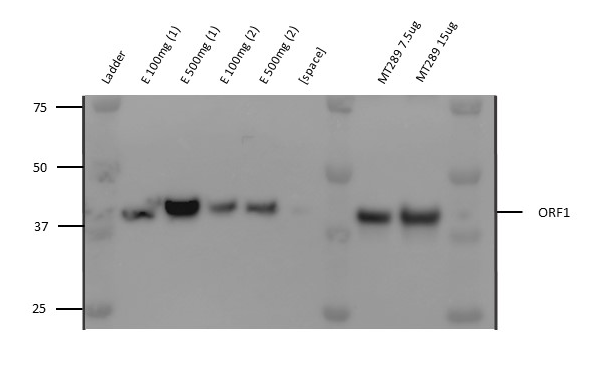
ORF1
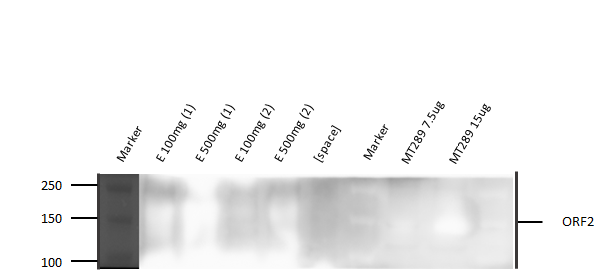
ORF2
DISCUSSION
ORF1 looks good and as expected. ORF2 however is massively overexposed. Looking at it though, there is definitely signal around 150 kDa, but from this blot there is no way of telling whether that's ORF2 of something else.
Comparing to MT289, the singnal seems to originitae a bit higher, and there also seems to be a signal below the 150 kDa that is not observed in the MT289 control. This is the same pattern that was seen before in restaining old blots with the polyHRP in 1. Detection of endogenous ORF2p in N2102Ep using Streptavidin-polyHRP80_Jan 29 2020.
Al the above should be confirmed by repeating the experiment.