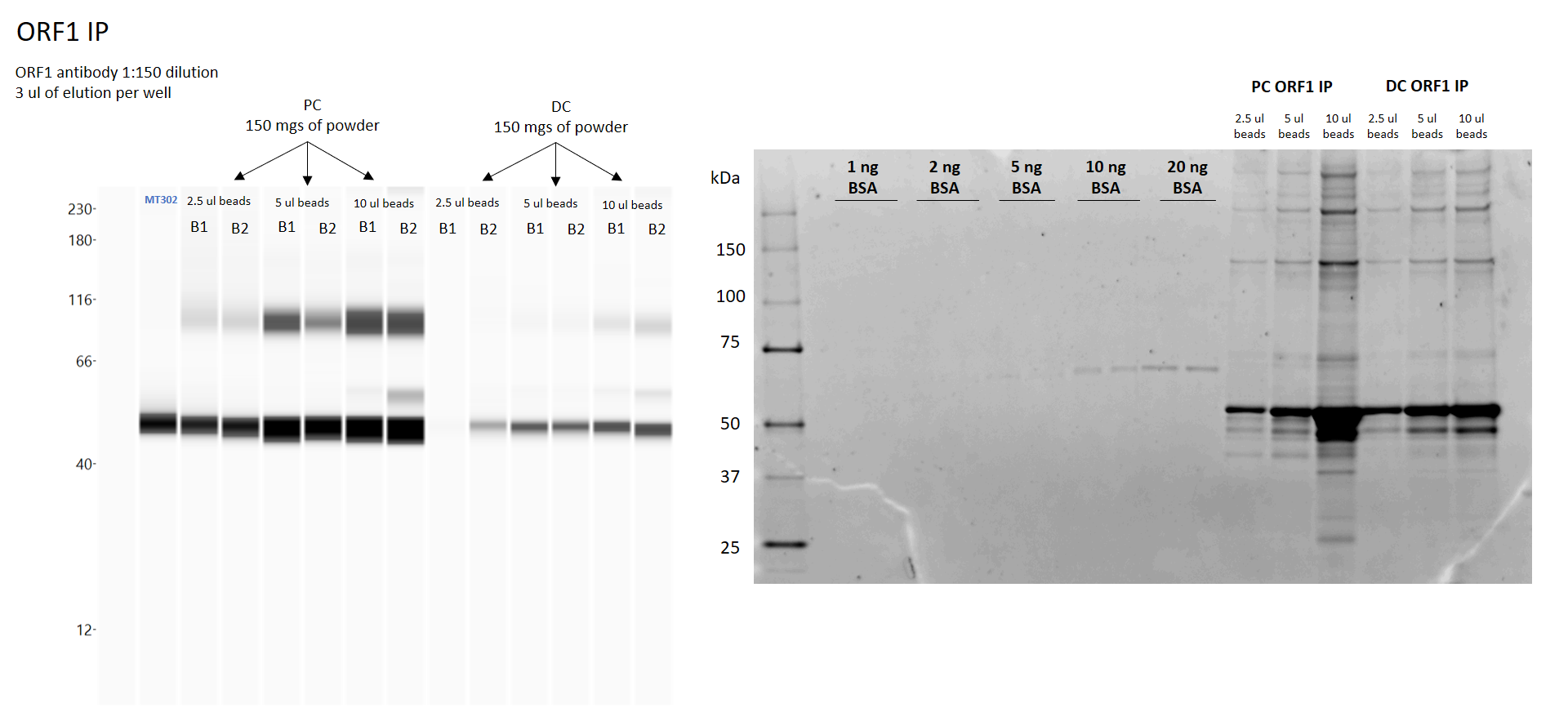
 After seeing this, we realised that the "ORF1 band", was running high (around 50 kDa). This was also happening in Wes.
However after seeing the sypro stained gel, we should make sure that the band was not IgG heavy chain (anti-ORF1 is a mouse IgG so IgG from the beads COULD also contaminate Wes signal).
After seeing this, we realised that the "ORF1 band", was running high (around 50 kDa). This was also happening in Wes.
However after seeing the sypro stained gel, we should make sure that the band was not IgG heavy chain (anti-ORF1 is a mouse IgG so IgG from the beads COULD also contaminate Wes signal).
We said that we were going to discuss this with Hua:
- (1) historically our gels show ORF1 at ~40kda — we can talk with Hua. There is one promising observation here. You used same bead amounts in PC and DC.. but signal is different… if signal was from beads alone… then signal should be the same.
- I ran the gel with MOPS, so: it is formally possible that the signal you are seeing on the Wes and that on the Sypro are not the same due to differences in the migration in those systems - totally possible that Wes is ORF1 and Sypro may be IgG.. would be easy to know with two controls: (1) beads only, (2) MT302
- In the sypro: Maybe 50 kDa bands could be the IgG (or might not be IgG either, could be nonspecific.. the nonspecific binding happens more when there is not enough target to occupy many antibodies) and the lower bands ORF1.
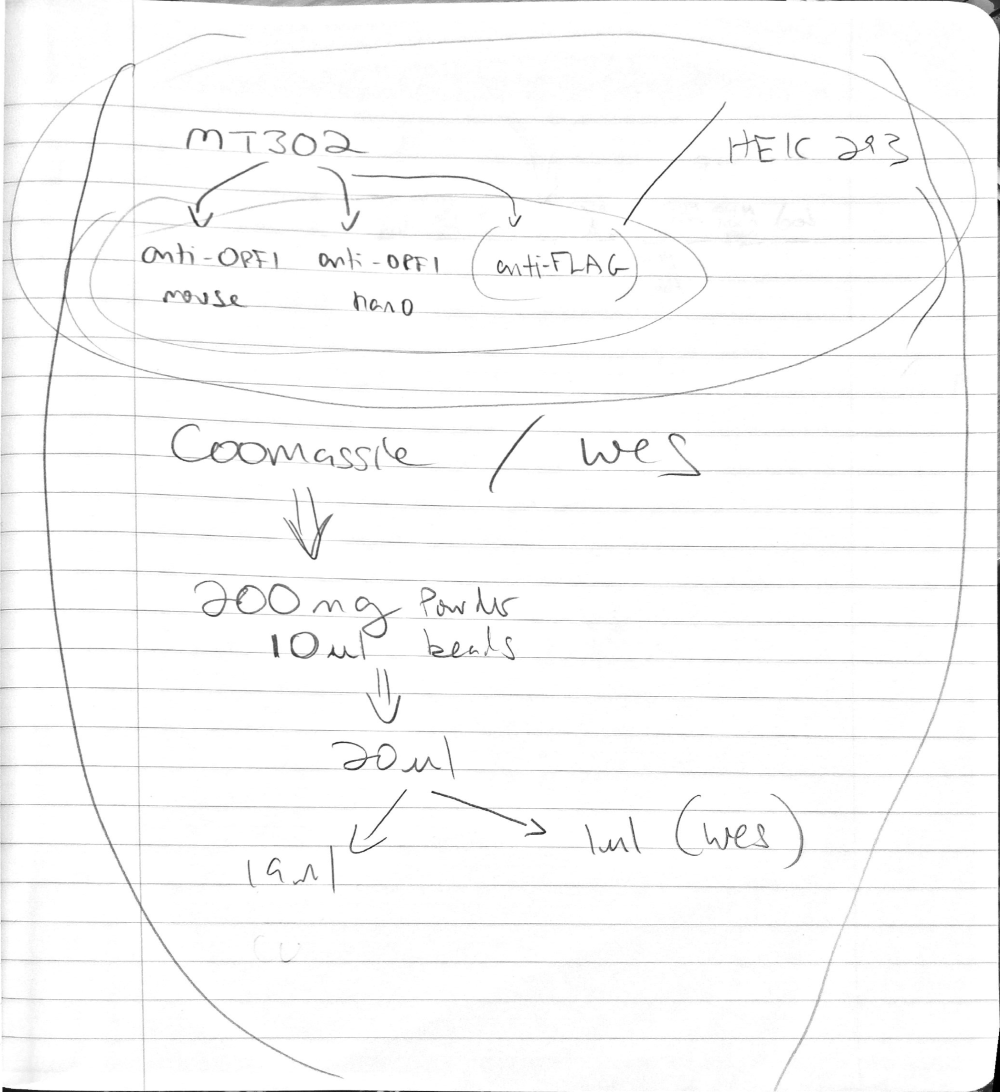
Then we decided to do:
Anti-ORF1 IP using MT302 material.
We KNOW this yields ORF1 band by stain and wes(tern)
Also: anti-ORF1 IP in non-expressing HEK - as control profile.
Sypro or silver + Wes
What we should see by wes:
(1) replication of MT302 result from prior Wes
(2) No bands in the beads only lane (or at least, bands that dont match MT302)
What we should see by sypro/silver:
(1) wether or not that 50kDa band is from IgG
(2) Where ORF1 appears relative to the 50kDa band (in MT302)
It seems also useful to do anti-ORF1 IP in HEK cells that DO NOT EXPRESS L1.
This can tell us if the 50kDa is nonspecific but not cross reactive in Western.
We have of course done all of these in the past - but always compared to high level ectopic expression and it is always good to do side-by-side until the result is so obvious to you that it becomes your second nature what is what. We are used to seeing ORF1 at ~40kDa.. so, I question the Sypro result… ORF1 is probably not the most intense band at ~50k… but the Wes result looks reliable for reasons stated. Still good to do controls to make 100% sure.
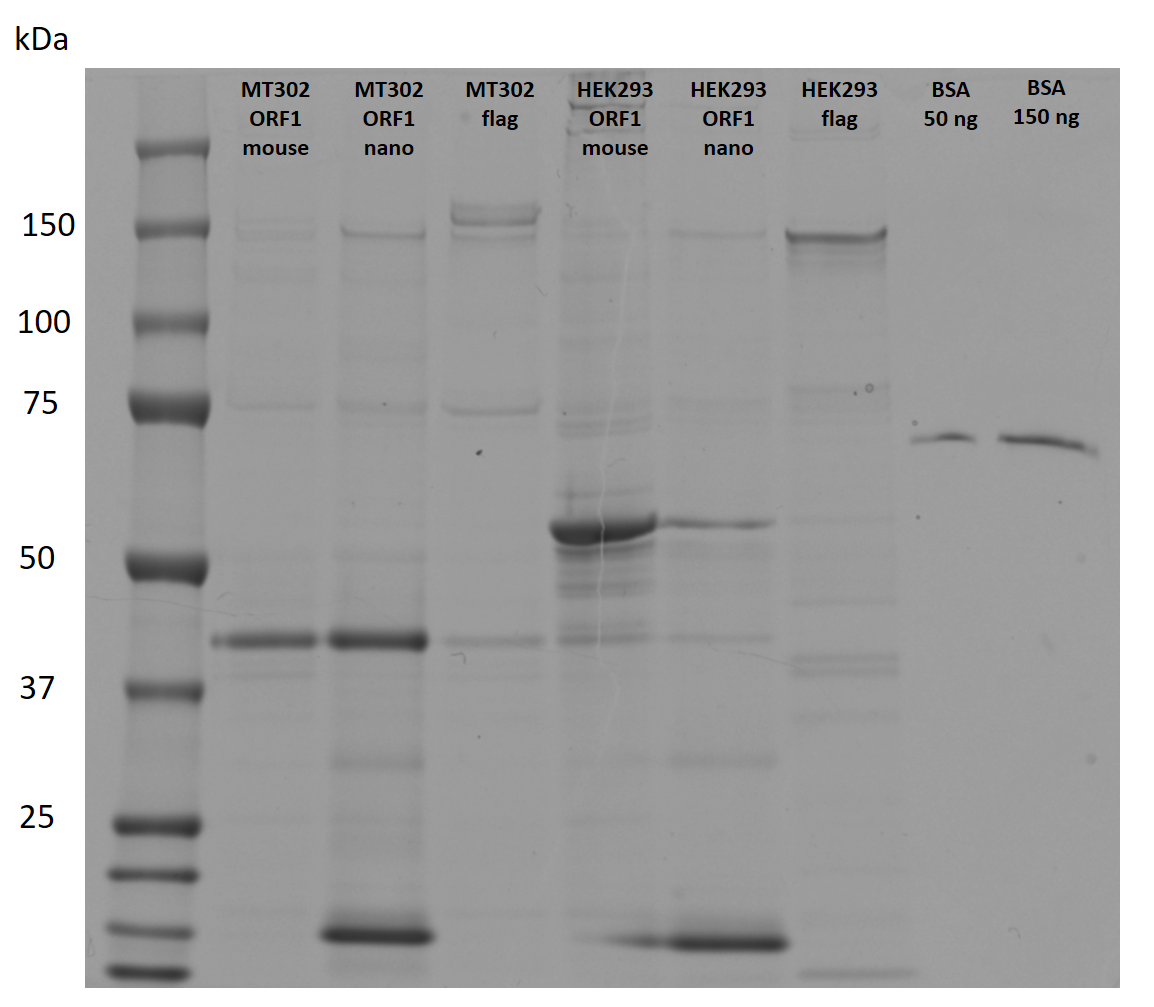
I did anti-ORF1 mouse, anti-ORF1 lama nanobodies and anti-flag IPs from 200 mgs of MT302 and HEK293 (I used 10 ul of beads and did the elution in 20 ul as in ORF2 IP (DC-H-t (B3), PC-H-t (B1), PC-L-ut (B1)) with anti-FLAG beads (Repetition), scalling the volumes for 200 mg of powder.
After this, I ran 19 ul in a gel and I kept 1 ul of elution for the Wes.
I ran a 10-well 4-12% Bis-Tris gel. Run 200 V for 40 minutes. After this I stained it with coomassie.
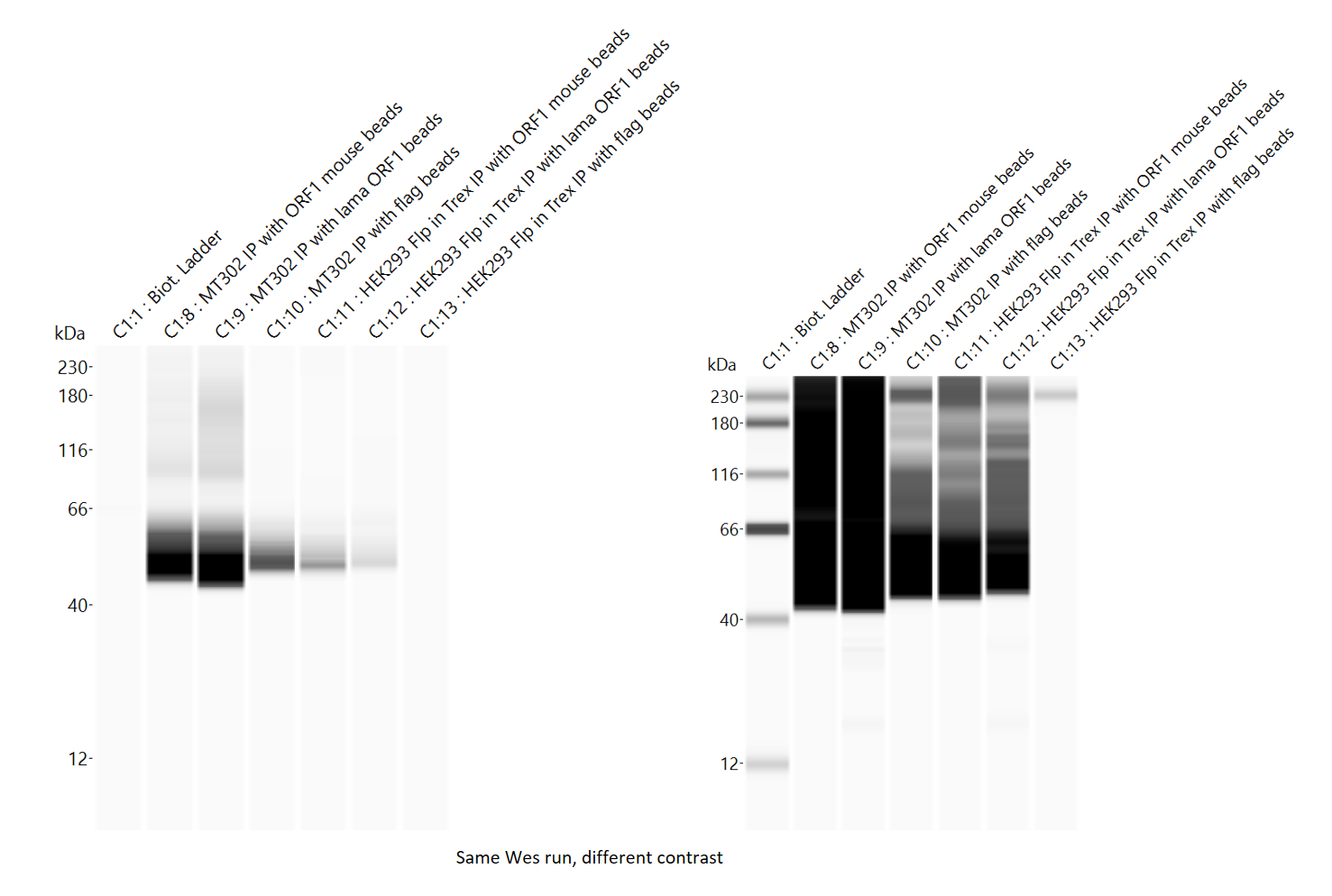
For Wes, I loaded the whole volume (1 ul from the elution). For the beads controi, I washed the beads 3 times (as I did with the IPs) and I did the "elution" as I did for the samples.
Finally, I did another IP, just with anti-ORF1 mouse beads in MT302 and HEK293 and only beads (this time I didn't wash the beads, I directly loaded the beads (that was a mistake)... and I stained it with coomassie.
