Polycarbonate centrifuge bottles
BECKMAN COULTER CENTRIGUGE TUBES ASSEMLIES POLYCARBONATE (LOT:P24128)
Tube Selection Considerations
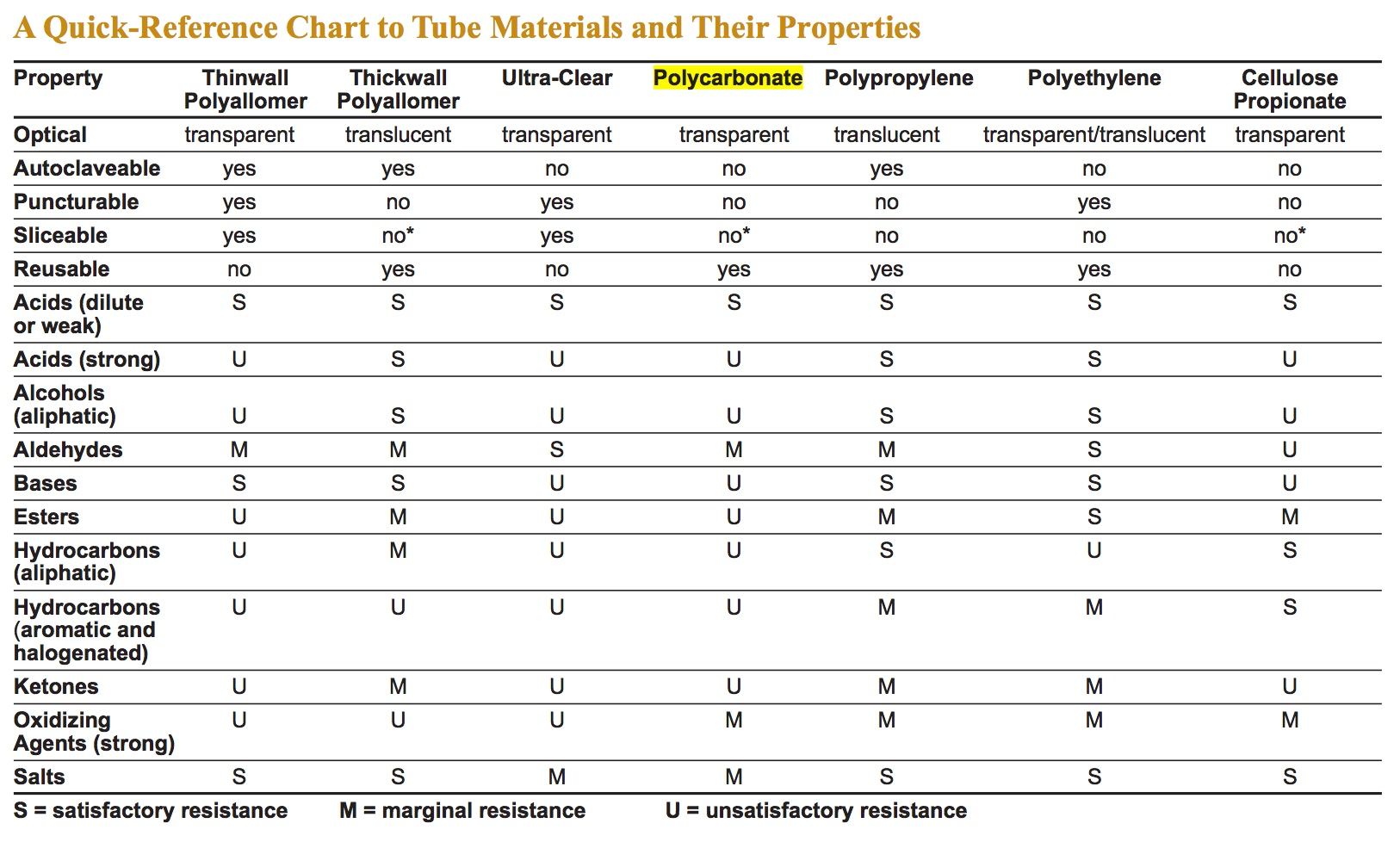
Compatibility of Tube Material with Solvents and Sample The chemical compatibility of the tube materials with the gradient-forming medium or other solvent is a prime consideration. Neutral sucrose and salt solutions cause no problem. But alkaline solutions, such as those frequently used for the separation of single-stranded forms of DNA, cannot be used in Ultra-Clear tubes or polycarbonate tubes and bottles. Sometimes DMSO is used in preparation of sucrose gradients for sedimentation of denatured RNA. Polycarbonate and Ultra-Clear tubes are incompatible with DMSO, so polyallomer tubes should be used. It must be emphasized, however, that other conditions of centrifugation (g-force, duration of run, etc.) have considerable effect on how well a tube material will withstand a particular solvent. Beckman Coulter publication IN-175, “Chemical Resistances for Beckman Coulter Centrifugation Products” (found on the Beckman Coulter web site at www.beckmanbuilt.com The type of sample, in some cases, will affect selection of a specific tube material. DNA, in its denatured or single- stranded form, will adhere to the surface of some tube materials. Polyallomer would be the best choice. (Most of this work is done in highly alkaline media which are incompatible with polycarbonate.) Lipoprotein separations are most often done in Ultra-Clear tubes because they are clear and sliceable; these properties simplify fraction location and recovery by tube slicing. When small lipoprotein samples are to be recovered by a fractionating device and clear tubes are desirable, there are alternatives: cellulose propionate, polycarbonate, and Ultra- Clear tubes. Hazardous materials, either pathogenic or radioactive, should be centrifuged with extreme care. All possible precautions must be taken to avoid leakage of the sample into the rotor cavity during centrifugation.
Gradient Formation and Fractionation
When choosing a tube for a density gradient run, some thought should be given to gradient formation and fractionation. If the bands or zones formed during centrifugation are indistinct, they may not be visible through a translucent material such as polyallomer. If optimum band visualization is important, Ultra-Clear tubes or tubes of polycarbonate or cellulose propionate should be used. Whenever collection of bands or zones must be done by puncturing the tube or slicing, a thin, flexible tube wall is required. Ultra-Clear or polyallomer tubes should be used, depending on the need for transparency. As there are currently no wettable plastic centrifuge tubes available, gradients should be loaded into plastic tubes from the bottom up to avoid mixing.
High Temperature Centrifugation
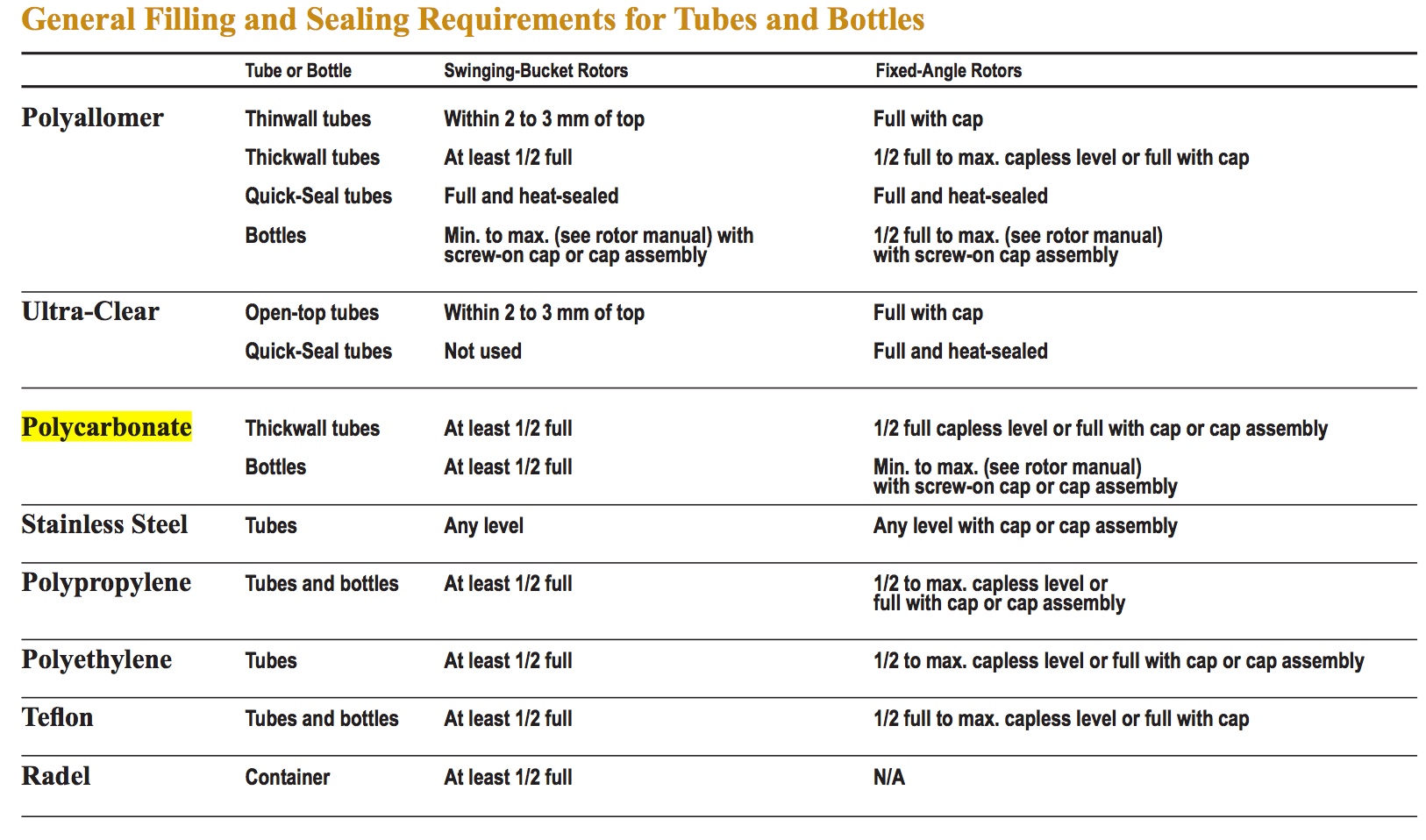
Although modern centrifuges and rotors can operate at temperatures as high as 45°C, one cannot assume that every tube can be safely run over 25°C. Stainless steel and glass are the only materials which will not experience some deformation when subjected to high temperatures and long centrifugation times. Plastic tubes undergo some degree of softening at temperatures higher than 25°C. Whether or not this will cause permanent deformation is not a question of temperature alone. The centrifugal force field used, the duration of the centrifugation, the type of rotor, and even the tube angle all have an effect. It’s obviously impossible to give exact temperature limits for plastic tubes when so many other variables are involved. The safest policy is to pretest the tubes under the actual experimental conditions, but with water, rather than a valuable sample. Tube Sizes Tube sizes as indicated in the following charts are nominal sizes, and may vary somewhat from actual filling capacities. If a thick-walled tube is run uncapped, the maximum filling volume will depend on the tube angle of the rotor to be used.
Tube Cleaning, Sterilization, and Reuse
If tubes are to be reused, special care must be taken during cleaning and sterilization. All tubes can be washed by hand with a mild detergent such as Solution 555 diluted 5-to-1 or 10-to-1 with water. This is particularly important for polycarbonate tubes and bottles which should not be exposed to a detergent with a pH higher than 8. Tubes and bottles should not be washed in commercial dishwashers as the detergents and high temperatures are too harsh. Solvents such as alcohol or acetone react unfavorably with many tube materials. If an organic solvent must be used in the cleaning procedure, consult bulletin IN-175 for a table of tube material/ solvent compatibilities The method chosen for sterilization has direct bearing on the number of reuses one can expect from a tube. Tubes and bottles of polyallomer, polyethylene, and glass can all be autoclaved, although in general, cold sterilization methods are not as harsh as autoclaving. Cold sterilization is recommended for both polycarbonate and Ultra-Clear. Do not dry tubes, bottles, or accessories in an oven. Labware should be air dried. OptiSeal, Quick-Seal, Ultra Clear, and thinwall polyallomer tubes are intended for one-time use and should be discarded after use. If maximum reuse is a major consideration, either polyallomer (preferably thick-walled) or polycarbonate tubes and bottles should be selected, and cold sterilization methods used. If these tubes are run completely filled in swinging bucket rotors, most of them can be reused a number of times. Chances of permanent deformation will be greater whenever the tubes are run in fixed angle rotors, without caps, and/ or partially filled. All of these conditions tend to stress the centripetal edge of the tube unduly. All tubes that have been used or autoclaved previously must be individually examined for signs of deformation or cracking before using them again.
Do not autoclave polycarbonate bottles, the polyethylene bottle rack (974627), or the spatula (363646). Use cold sterilization methods as described below. Low concentrations of hydrogen peroxide (less than 6%) and bleach (less than 10%) may be used on all rotor components, bottles, and accessories. Ethanol (70%) may be used on all rotor components except the polycarbonate bottles and plugs. Hydrogen peroxide and bleach may cause discoloration and corrosion of the anodized rotor surfaces. Use the minimum exposure time for each solution, rinse thoroughly with distilled water, and dry with a soft cloth, per laboratory standards. No guarantee of sterility or disinfection is expressed or implied through the use of these disinfection methods.
Tube Closures
When other considerations have been resolved, convenience may be a deciding factor. Without a doubt, the most convenient tube closure is none at all; none are required for tubes run in swinging bucket rotors and in the Airfuge Air-Drive Micro-Ultracentrifuge. For tubes run in fixed angle rotors, alternatives to the standard tube cap assemblies are available. Bottles have three-piece cap assemblies which are easier to use than the more complex tube cap assemblies. Polycarbonate bottles are available for general-purpose fixed angle rotors, and are used frequently for differential centrifugation where band recovery is not a problem. Thickwall tubes can be run in all fixed angle rotors without caps, provided they are partially filled. (Refer to rotor manuals for more information on fill volumes.)