I did several IPs with different amounts of mouse anti-ORF1 beads (2.5, 5 and 10 ul of beads) in duplicates.
Date: 07/23/18
Cell lines:
DC 150 mg of powder
PC 150 mg of powder
Extraction/wash buffer: 20mM HEPES, pH7.4, 1% Tritonx-100, 500mM NaCl (with protease inhibitors)
Scale: 50mg per IP reaction with 2.5, 5 or 10 ul of mouse anti-ORF1 beads
I used 500 mM NaCl, for the sonication of the 150 mgs I sonicated for longer than in the standard protocol (5x 2sec @ 2 Amp with the new sonicator) because I still could see a big cell pellet after 5x2 seconds with the new sonicator). I did 5x2 seconds 4 times (letting the tubes in ice for 30 seconds between each cycle).
Weigh out 150mg of powder/cell line, add 600ul of extraction buffer to each tube (1:4 w/v), vortex to mix
5x 2sec x 4 times @ 2 Amp with the new sonicator. I let the tubes cool in ice for 30 seconds between each cycle.
Spin @ 20k rcf, 4°C for 10’ (Eppendorf Centrifuge 5417R) - 20' for the DC samples
After the spin 20000 rpm 10 minutes, PC samples were normal, clear as always and with a little pellet left, but DC samples looked different. I think that when we harvested the cells we still have the matrigel and it may be contaminating the samples (however I don't think this could be a big deal). I transfered the supernatant carefully, trying not to take the pellet that was in the wall of the tube.
I spinned DC samples two times, so it was 20000 rpm 20 min.
Collect the cleared lysate, save 25ul. I splitted each lysate in 3 tubes, for doing 50 mg powder IPs with three different amounts of beads (2.5, 5 and 10 ul)
Save the pellets; resuspend each pellet in 600ul of 2% SDS/40mM Tris, pH8;
IP @ 4°C for 30’
Save the flow-through
Wash 3x 1ml extraction buffer
Transfer beads to fresh tubes after 1st wash.
Add 15ul of 2% SDS, 40 mM Tris pH 8 and elute @ 70°C for 5’with shaking.
I did the rest of the IPs normally, and I made the elutions in 15 ul of the buffer I have been using.
After this, I ran a Wes loading 3 ul of elution per well. I loaded supernatants and pellets as well, but I couldn't detect ORF1 in any of them, even increasing the contrast as much as possible. I also loaded the highest amount of material allowed by the Wes system and I used a antibody dilution of 1:50 for the sup and pellet (I don't show the data because there were no clear signals).
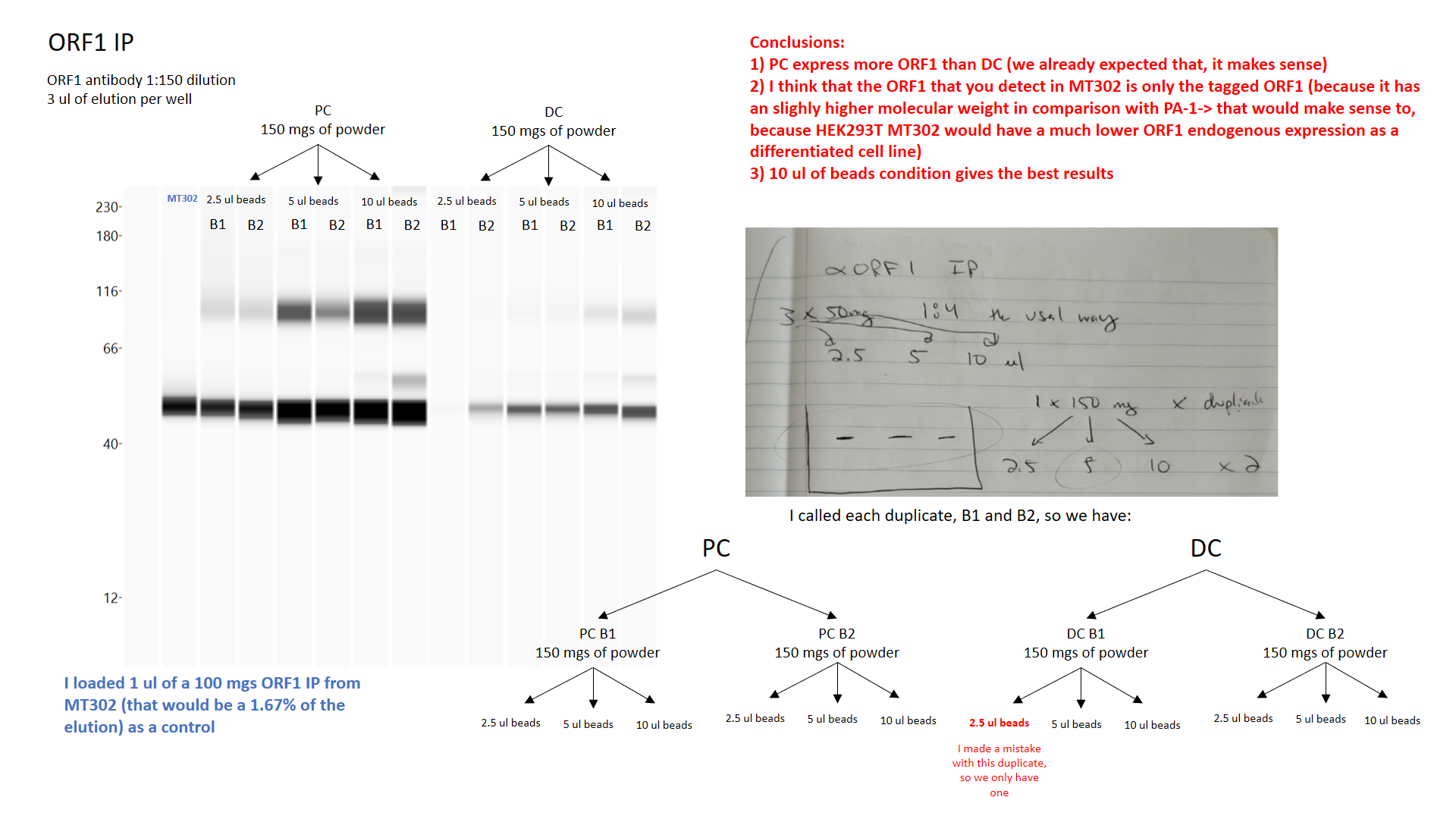
However, later we realised that the Wes/ 2º Ab/ORF1 mouse Ab wasn't detecting ORF1, but something else (maybe the heavy chain of the mouse anti-ORF1 or another contaminant).
UPDATE FROM THE 2019 STAY: WE PROVED THAT THE BAND WAS ORF1, THUS, THE PA-1 PC HAD DOUBLE THE ORF1 SIGNAL THAN THE PA-1 DC (With matrigel)
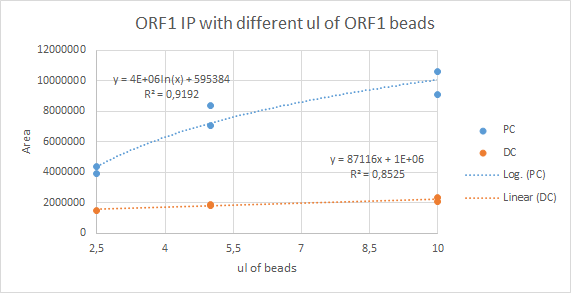
We produced the standard curve of ORF1 to see if the increase was linear with more beads, and compare PC and DC.
After this, we also did a sypro stained gel of the materials, using different amounts of BSA as standards.
(One 50 mg IP per lane)
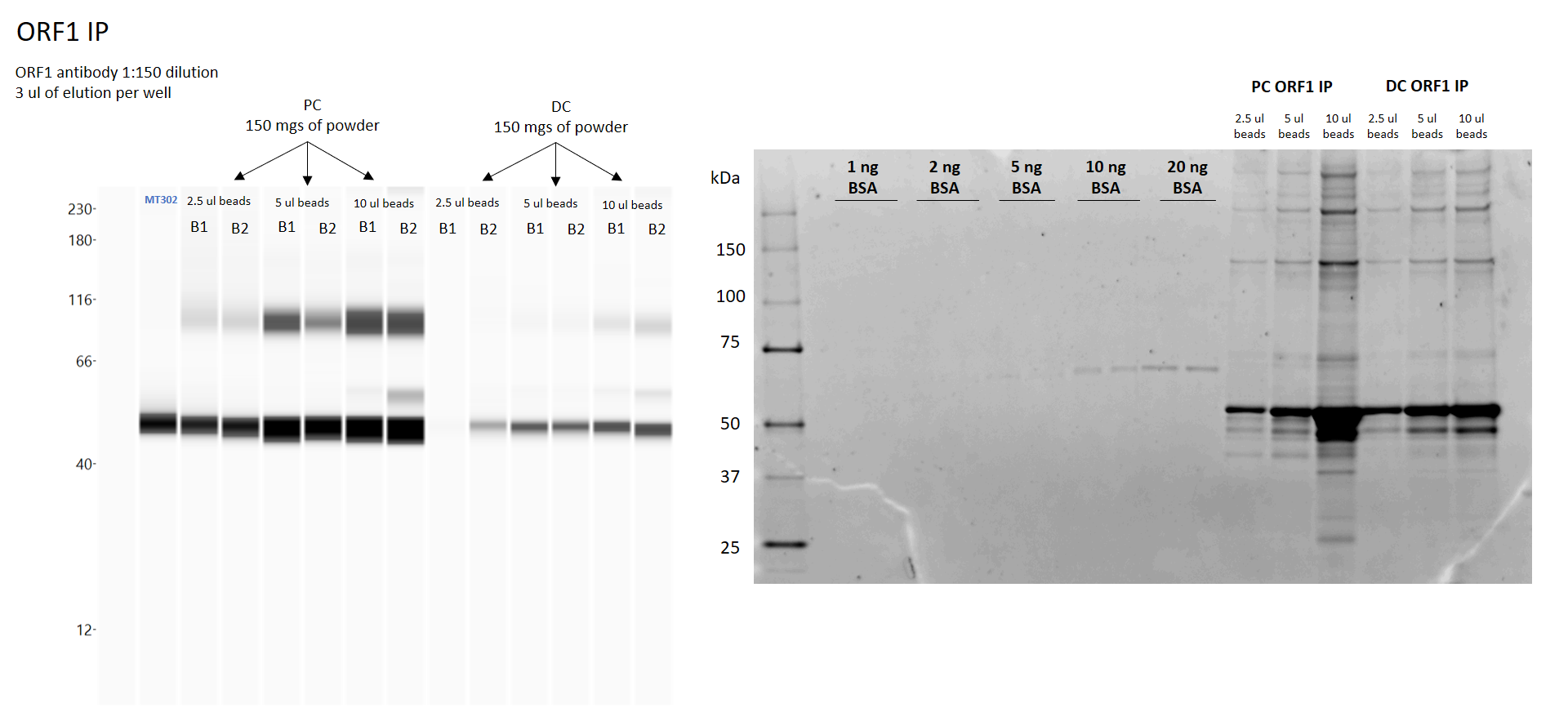
After seeing this, we realised that the "ORF1 band", was running high (around 50 kDa). This was also happening in Wes.
However after seeing the sypro stained gel, we should make sure that the band was not IgG heavy chain (anti-ORF1 is a mouse IgG so IgG from the beads COULD also contaminate Wes signal).
This is what we did: