Plasmids used:
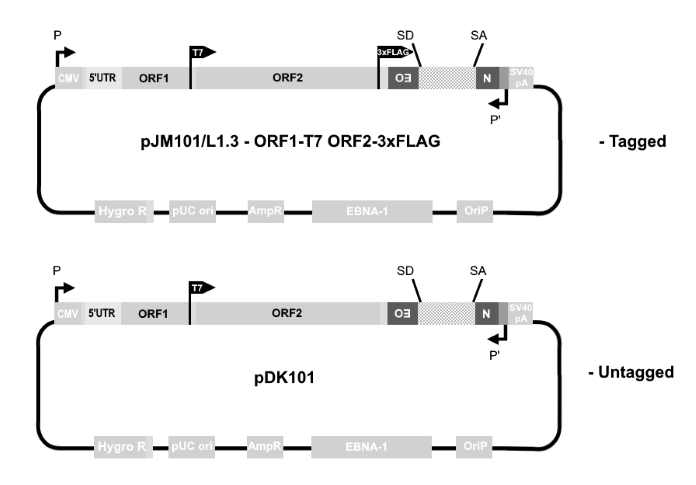
- Tagged: pJM101/L1.3 – ORF1-T7 ORF2-3xFLAG is a pJM101/L1.3 modified by PCR mutagenesis to contain the T7 and 3xFLAG genes.
- Untagged: pDK101 is pJM101/L1.3 modified by PCR mutagenesis to contain the T7 gene 10 eleven amino acid (MetAlaSerMetThrGlyGlyGlnGlnMetGly) epitope tag.
The first objective was to use the PC and DC material (transfected cells) that I had prepared in Spain to do MS (with SILAC/I-DIRT). But first we should determine a few things.
Relative expression levels and purification profiles of PC-H-t and DC-H-t.
- 1) T1 - Relative protein quantity per mg of powder
- 2) Relative amounts of expressed ORF1/ORF2
- T2 - Antibody validation + testing - ORF1p, ORF2p, T7, FOFX2, 3xFlag in DC-H-t (with spare batch 3) - However the Wes didn't work (we didn't see any clear bands corresponding with any of the expected signals). I don't show the Wes results because we can't see anything.
- T3 - Antibody validation + testing (OCT4 and FOFX2 in PA-1) - I was going to do this, but finally I didn't because the antibodies wasn't working in Wes and we couldn't detect ORF1/ORF2
- T4 - Determine the relative expression levels & purification profiles of PC-H-t, PC-L-ut and DC-H-t - I was going to do this but finally I didn't because we weren't able to detect ORF1/ORF2 in PC or DC
- T2 - Antibody validation + testing - ORF1p, ORF2p, T7, FOFX2, 3xFlag in DC-H-t (with spare batch 3) - However the Wes didn't work (we didn't see any clear bands corresponding with any of the expected signals). I don't show the Wes results because we can't see anything.
We were not able to detect ORF1 in the DC samples of PA-1, so I move to normal Western blot and stopped the other determinations (there was no point in doing them if we couldn't detect ORF1/ORF2)
- Western blot to detect ORF1/ORF2-flag in DC and PC
05/23/18 - ORF2 IP (DC-H-t (B3), PC-H-t (B1)) with anti-FLAG beads
We couldn't detect ORF2 in the lysate, pellet or elution from flag-beads IP. To check that the material that we were loading for DC and PC was enough/similar, I stripped the membrane and incubate it with PCNA as a control. PCNA was present in DC and PC. Then I repeated the same western to verify that results were reproducible. Repetition:
05/29/18 - ORF2 IP (DC-H-t (B3), PC-H-t (B1), PC-L-ut (B1)) with anti-FLAG beads (Repetition)
The results were exactly the same – We thought that maybe, the extraction conditions could be affecting the detection, as we could be losing ORF1/ORF2 during the extraction. Then we tried to detect ORF1/ORF2 in the whole extract from a Total protein extraction.
05/29/18 - Total Protein Extraction with SDS buffer (DC-H-t (B3), PC-H-t (B1), PC-L-ut (B1))
I did two westerns, one loading 25 ug of total protein, and another loading 50 ug of protein. We couldn’t detect ORF1 nor ORF2-flag in the DC/PC samples.
Conclusion: We can’t detect endogenous ORF1/ tagged ORF2 in the PC and DC samples.
Then, I tried doing IPs with anti-ORF1 beads (to capture endogenous ORF1 instead of ORF2-flag) in PC, DC, PA-1 and MT302.
06/06/18 - ORF1 IP (DC-H-t (B3), PC-H-t (B1), PC-L-ut(B1), PA-1, MT302) with anti-ORF1 beads (50 ug protein)
We only were able to detect ORF1 in the elutions from PA-1, PC and DC. Then, even when maybe we could have done proteomics with this material, we were detecting endogenous + exogenous ORF1, so this experiments wouldn’t be very “clean”.
After this we decided to switch to try to capture endogenous ORF1 instead of endogenous/exogenous ORF2 from DC and PC.